
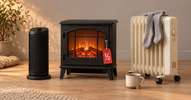
Space Heater vs Electric Fireplace vs Oil-Filled Radiator: Which Is Cheapest to Run in Canada?
, by Half Price Store Team, 7 min reading time
, by Half Price Store Team, 7 min reading time
Every 1,500 W electric heater costs the same per hour to run. What differs is how fast you feel the heat and how well the room holds it. Here's how ceramic heaters, oil-filled radiators, electric fireplaces and infrared panels compare, with the running-cost math.
Short answer: every plug-in electric heater turns electricity into heat at the same rate, so a 1,500 W space heater, a 1,500 W electric fireplace and a 1,500 W oil-filled radiator all cost the same per hour to run. What differs is how fast you feel the heat, how evenly the room holds it, and how much it costs to buy. Pick by the room, not by the running cost.
A heater's wattage is its cost. At full power a 1,500 W unit uses 1.5 kWh every hour. Ontario's regulated time-of-use rates (Ontario Energy Board, prices effective November 1, 2026) are 9.1 cents per kWh off-peak, 14.6 mid-peak and 18.9 on-peak before delivery charges, so that works out to roughly 14 to 28 cents an hour. Eight hours a night through a 30-day month at the mid-point is about $50. Rates vary by province and utility, so check your own bill, but the ranking between heater types never changes: same watts, same cost.
The only way one heater is "cheaper" is if it reaches your target temperature and then cycles off. That is where thermostats, timers and the right type for the room earn their keep.
| Ceramic / fan space heater | Oil-filled radiator | Electric fireplace | Infrared panel | |
|---|---|---|---|---|
| How it heats | Fan pushes air over a hot element | Element warms sealed oil; heat radiates and convects | Fan heater hidden behind a flame display | Radiant heat on people and objects, not air |
| Time to feel warm | Minutes | 15–30 minutes | Minutes | Almost instant, in its line of sight |
| Heat after switch-off | None | 30–60 minutes | None | None |
| Noise | Fan hum | Silent (occasional ticking) | Fan hum, optional crackle sound | Silent |
| Surface temperature | Hot grille | Warm to hot fins | Cool glass, hot vent | Warm panel |
| Best for | Quick heat in an office, bathroom or workshop | Bedrooms and rooms you keep warm for hours | Living rooms where the look matters | Drafty spots, garages, patios |
| Typical new price | $40–$120 | $70–$180 | $200–$600 | $100–$300 |
The $50 box from the hardware store. It heats the air in front of it within minutes and stops the second you switch it off. Good for a home office you use four hours a day, a cold bathroom in the morning, or taking the edge off a basement workshop. Weak for a bedroom, because the fan runs all night and the room cools the moment it cycles off. Look for a tip-over switch, overheat cut-out and a thermostat that actually holds a temperature rather than just high/low.
The oil never needs topping up; it is a sealed heat reservoir. Radiators take a while to warm up but then hold the room at an even temperature with no fan noise, and they keep radiating for up to an hour after the thermostat clicks off. That cycling is why many people find them cheaper to run in practice: the element is off a large share of the night. They are the right choice for bedrooms, nurseries and any room you keep warm for long stretches. The downsides are weight (10–15 kg) and a slow start.
Inside almost every electric fireplace is a standard 750/1,500 W fan heater. You are paying for the LED flame, the cabinet or insert, the remote and the crackle sound, not for better heat. That is fine if you want a focal point for a living room or a condo without a real fireplace; just don't expect it to heat more than the one room it is in. Inserts that slide into an existing firebox are the cheapest route if you already have the opening. Flame effects run on about 10 W, so leaving the display on with the heat off costs almost nothing.
Infrared heaters warm whatever is in front of them directly, the way sun through a window does. In a drafty garage, a covered patio or a workshop with high ceilings, that is far more effective than trying to heat all the air. Indoors, wall-mounted panels work in hallways and bathrooms, and plug-in radiant floor mats under tile do the same job from below. They are not good at warming a whole room evenly.
Plug portable heaters directly into the wall, never into a power bar or extension cord. Keep a metre of clearance from bedding, curtains and furniture. Choose units with a tip-over switch and overheat protection, and switch them off when you leave the room. These apply equally to new and open-box units.
Prices checked October 22, 2026. Every unit is a single item, so a link below may show as sold; the heaters & radiators collection always shows what is in stock today. At the time of writing, open-box heating in our stock includes:
Every unit is one of a kind and tested before listing. See what is in right now in heaters & radiators and appliances & climate. Free pickup in Etobicoke, free shipping in Ontario over $150, 30-day returns.
Not per hour at the same wattage. It often costs less per night because it holds heat and cycles off more, while a fan heater runs continuously.
No. It is a 1,500 W fan heater and will warm one room of up to about 35 m². Treat it as zone heating with a nice flame.
An oil-filled radiator with a thermostat and tip-over switch is the type most people are comfortable running overnight. Keep clearance and plug it straight into the wall. Fan heaters are better switched off when you sleep.
A rough rule is 10 W per square foot of floor, so 1,500 W covers about 150 sq ft (14 m²) comfortably in a typical insulated Canadian room. Drafty or high-ceiling rooms need more, or a second unit.
Keep reading: Open-box space heater deals in Canada · Is it safe to buy open-box?


